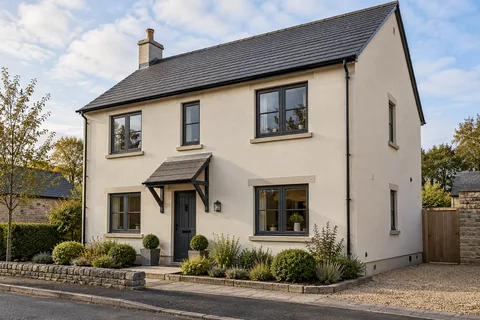
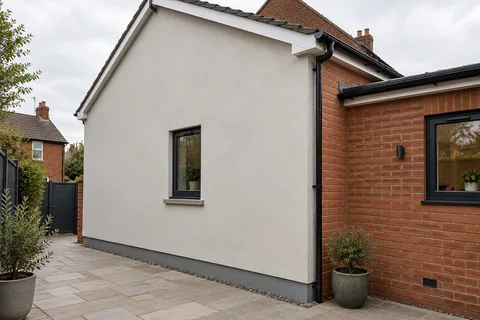
Mixed backgrounds
One Finish Over Brick, Block, Stone and Old Render
Once the old render or pebbledash is off, many houses do not reveal one tidy material. A stone front, a brick back, a block-built extension, a bricked-up doorway and patches of old cement render can all end up under the same finish. One colour across the house is achievable, but each background behaves differently and is prepared differently. This guide explains what changes from one to the next.

On this page
Why the background matters under a thin finish
A modern finish coat is thin. K Rend's Silicone TC goes on at the thickness of its largest grain, 1.5 or 3 mm, so a silicone finish cannot disguise differences in the wall behind it. Those differences show in two ways: in how strongly each material draws water out of the fresh base coat, which affects how well it bonds and cures, and in how each part moves, which shows as cracks along the lines where materials meet.
That is why the base coat does the levelling work. A base such as K Rend's HP14, nominally 4-6 mm, goes over blockwork, masonry or stone and gives the finish one consistent surface to sit on. K Rend's data sheet says refurbishment work and unusual backgrounds need technical advice, which describes most mixed-material houses. Ask for that advice to be written against each background, not as one line for the whole house.


Brick, block and stone: preparing each one
Brick varies more than people expect. Hard, smooth bricks offer little key, while soft old bricks can be very absorbent. K Rend's guide lists R7 and R10 primers for backgrounds with low key or high suction, and high-polymer base coats for awkward surfaces such as dense block, lightweight block and high-suction brick. Raking out the joints is not enough on its own: Lime Green's guidance says raked joints alone do not give sufficient key.
Concrete blockwork in an extension or a rebuilt wall is usually the simplest background, and it is the one a monocouche is written for: K Rend specifies K Mono over moderate to low strength blockwork. On the same house, a monocouche that suits the extension may not suit the old brick or stone, which is one reason whole-house jobs often use a base coat and thin finish throughout instead.
Stone needs the most thought. Sheffield's management proposals for Grenoside, a village of nineteenth-century houses built for quarry workers and millstone makers, list walls rendered with concrete among the changes that weakened its historic buildings. SPAB's advice is that rigid cement render on old walls restricts evaporation, cracks and traps water. On solid stone the right answer may be a lime render, with a different system on the newer parts and the colour matched as closely as the materials allow.
Filled openings, old patches and the lines between materials
Altered walls carry hidden joints. A bricked-up doorway, a blocked window or a rebuilt corner puts newer material into an old wall, with a joint round its edge that can move. Old cement patches, chases cut for cables and holes left by removed pipes do the same on a smaller scale. While the render is off, mark each one on an elevation sketch and photograph it before it disappears.
Where two materials meet, the base coat is reinforced. K Rend's guide describes alkali-resistant glass-fibre mesh as a way to reduce stress at typical stress points such as door and window reveals, and the edges of a filled opening behave in a similar way. The mesh is embedded in the base coat and carried well past the joint on both sides, so that movement is spread rather than concentrated along one line.
Some joints should stay as joints. Where an extension meets the house or the structure changes, a movement bead lets the render move instead of cracking, and a stop bead against retained brick or stone gives a clean edge. A neat line at a corner is far better than a crack across the middle of a wall.
As a hypothetical example, take a Victorian villa with a coursed stone front, brick side and rear walls, a bricked-up side door and a 1980s block-built kitchen. A sensible plan might leave the stone front exposed or give it a lime render, prime the soft brick and base-coat it with mesh carried across the old doorway, base-coat the blockwork directly, and run one thin finish over the brick and block. The joints would fall at the front corners, where the stone stops, and at the kitchen junction, where a movement bead lets the two structures move independently.
Keeping one colour across different parts
With the backgrounds prepared and base-coated, the finish can go over the whole house in one colour. Each elevation should be finished in one continuous run, since K Rend's Silicone TC sheet asks for a wet edge and continuous surfaces finished without interruption, and the same sheet recommends a test panel. If part of the house is lime and part silicone, make samples of both side by side and judge them in daylight, because the two materials will not look identical.
Keep the elevation sketch with the handover papers. Years later, a fine crack along the edge of a filled doorway makes sense when the record shows the doorway; without it, the crack looks like a failure of the whole wall. K Rend's guide lists Colour Fill, a filler for small cracks and holes in its renders, but its maintenance advice is to find out first whether the crack is still moving. For the broader view of re-rendering a whole house, the homepage guide to Sheffield house rendering links the services involved.
Common questions
Can new render go straight over old render?
Only if the old render is sound, well bonded and accepted by the new system's manufacturer. K Rend's own FAQ says an existing layer should be stripped back until there is a stable substrate. Sounding the wall shows where it is hollow.
Will a bricked-up doorway show through the new finish?
It should not show as a colour difference if the base coat and finish are applied evenly, but a fine crack can appear along its edges if the joint moves. Mesh carried across the joint in the base coat reduces that risk.
Does every part of the house need the same base coat?
No. The base and primer can change from one background to another as long as the system manufacturer accepts each combination. The finish coat is what has to be consistent.
See housing and planning information for Sheffield and nearby places, including the source and geography behind each figure.