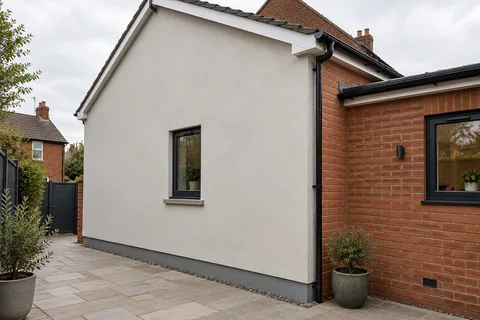
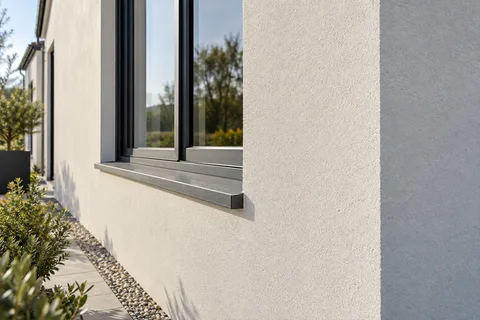
Monocouche, whole house
Monocouche Render Sheffield: Rendering a Whole House
Monocouche is a through-coloured cement-based render applied in one thick pass and scraped to an open, matt texture. Because the colour runs right through it, it needs no paint, and scratches or chips show the same colour beneath. Rendering a whole house in monocouche is mainly a planning exercise: each section has to be applied and scraped within a short window, so the way the house is divided up decides how the finished walls look.

On this page
How a monocouche goes on
K Rend's K Mono is a typical example. It is applied in one pass to 17-18 mm, ruled flat, left to set for between 3 and 24 hours depending on the background and drying conditions, then scraped back to leave a nominal 16 mm finished thickness and the characteristic texture. Small areas such as reveals and quoins can be finished smooth for contrast. K Rend says the surface should not be polished.
The scrape is what gives monocouche its look, and it has to fall inside the product's setting window. On a whole house that means each elevation, or each panel of a large elevation, is applied in an order the gang can keep up with, and joins are planned rather than left to wherever the day ends.
Strip old render and repair the masonry; check the background suits the product.
Fix beads, including stop beads where day joints will fall.
Apply in one pass to the specified thickness and rule flat.
Leave to set, then scrape the whole panel at the right moment.
Finish reveals and quoins, refit fittings and protect the base of the wall.
- Background Usually blockwork or brick; uneven or mixed walls may need a levelling coat.
- Beads and mesh Beads at corners, reveals and the base; mesh over junctions and lintels.
- Monocouche passes One through-coloured material, applied in passes to the specified thickness.
- Scraped surface Scraped once partly set, which removes the skin and leaves the texture.
Wall on the left, finish on the right. Not to scale: coats, thicknesses and primers follow the chosen manufacturer’s system and the condition of the wall.
Which Sheffield houses it suits
K Mono is described as a finish for moderate to low strength blockwork, which is why monocouche is so common on newer houses and extensions. On an older brick house, painted render or a dense background, the manufacturer's base coats and primers come into play: K Rend's product guide lists an HPX base for lightweight block and high-suction brick, and an HP12 base with its R7 primer for dense or low-key backgrounds. Part of the job on an older house is getting the whole of every elevation onto a background the product can bond to.
It is a poor match for solid stone houses that need to dry outwards. SPAB explains that dense cement-based renders on older solid walls restrict evaporation and crack, letting water in and trapping it. Grenoside's conservation-area management proposals list walls rendered with concrete among the changes that harmed the village's stone buildings, so a monocouche on an old stone house there is unlikely to be welcome.
Panels, joints and the whole-house look
A whole house in monocouche is divided into panels that can each be applied and scraped in one session. External corners, window heads and sills, string courses and changes in the wall line are the natural breaks. Where a long wall cannot be finished in one session, a bead at a downpipe line or a deliberate joint is better than a ragged join across open render. Movement joints required by the wall's construction, such as where an extension meets the original house, are carried through the render rather than rendered over.
Colour consistency across the house depends on the same product and colour reference on every elevation, and on similar thickness and timing of the scrape. Ask to see a scraped sample, not a colour chip, and look at it on both a sunny and a shaded wall before the whole house is ordered.
Aftercare and later recolouring
Monocouche is washed rather than painted. K Rend's FAQ advises washing its through-coloured renders instead of painting them, because paint loses the render's water repellency and breathability. Its maintenance advice is a low-pressure fan nozzle with mild detergent, top to bottom, every few years, and a biocide where algae has taken hold on damp walls.
If a whole house of scraped render has faded or stained unevenly after many years, K Rend offers a coating, Colour Enhance, designed for existing scraped render. That is a recolouring job rather than a re-render; the respray page covers it. Small cracks and chips can be filled with a colour-matched filler before any coating.
Common questions
Is monocouche really one coat?
It is one coat of render, usually applied in one pass to around 17-18 mm and scraped back. Preparation, beads and, on difficult backgrounds, a base coat or primer still come first.
Can an old brick house have monocouche?
Often, but the background has to suit the product. Dense, painted or high-suction walls may need a base coat or primer first, and a solid stone house may be better in lime.
See housing and planning information for Sheffield and nearby places, including the source and geography behind each figure.