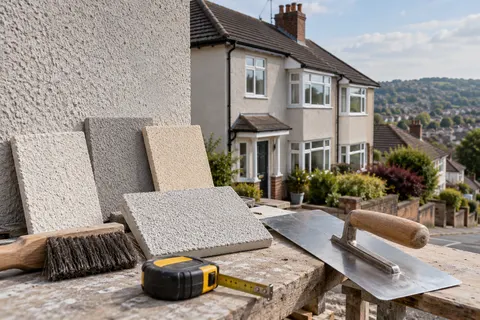
Whole-house pebbledash
Pebbledash Removal Sheffield: Stripping a Whole House
Pebbledash is a render base coat with small stones thrown onto it while it is still wet. Taking it off a whole house is heavy, dusty work, and what it reveals decides what goes back on. Before committing, it is worth knowing that stripping is not the only option.

On this page
Strip it or coat over it
If the dash is firmly bonded across the house and you simply want a different look, it can sometimes be overcoated rather than removed. K Rend's product guide lists an overcoating dash receiver designed for refurbishment and applied over existing dry dash, so a new dash can go on without a separate base coat. Overcoating keeps the old coat as part of the wall, so it only makes sense where that coat is sound everywhere.
Stripping is the answer where the dash is hollow, cracked or falling away, where it has been patched so often that nothing will sit flat over it, or where a lime render is wanted on a solid wall. Sounding every elevation from the scaffold tells you which situation you are in, and a house can end up with both: stripped on a failing front, overcoated on a sound rear.
- Trial area A small patch is taken off to see how well the dash is bonded and what lies beneath.
- Removal Dash and backing render are hacked off to masonry or to a sound backing coat.
- Clear and dispose Debris is bagged or skipped; this is heavy, dusty and noisy work.
- Repair the masonry Exposed bricks, blocks and joints are repaired before anything new goes on.
- New render system The wall is rendered with the chosen system, or left as fair-faced masonry if suitable.
The usual order of work. The survey and the chosen products decide the actual steps.
What stripping a whole house involves
The dash and its base coat are hacked off with hammer and bolster or a breaker, working down each elevation from the top lift of the scaffold. The volume of debris on a whole house is large, so skips, sheeted scaffold and protection for paths, drains, glazing and borders are part of the job. On a terrace or semi, the work has to stop cleanly at the party line so the neighbour's dash is left intact; a stop bead along that line gives the new render a straight edge.
SPAB's advice on removing hard cement-based coats from older walls applies here: try a small area first, work carefully with hammer and chisel, and avoid levering off large sheets, which can rip the face off soft brick or stone. Where dash on part of a wall is still well bonded and the wall is not going back to bare masonry, leaving that part and overlaying it can do less damage than forcing it off.
Scaffold and sheet each elevation; protect glazing, paths and drains; arrange skips.
Trial-strip a small area on each face to see how the dash comes away and what is beneath.
Hack off the dash and base coat elevation by elevation, stopping cleanly at party lines.
Clean down, rake out loose joints and repair damaged brick, stone and infilled openings.
Dub out hollows so the new base coat is even, then fix beads.
Apply the new render system and refit fittings.
What you are likely to find underneath
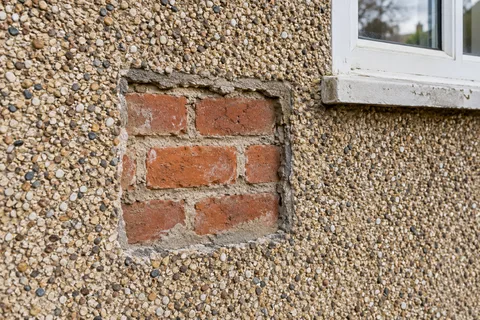
Under a whole house of dash you may find common brick with patched joints, bricked-up doorways and windows, steel or concrete lintels, old service holes and the outline of earlier extensions. Brick faces damaged during stripping are normal. For that reason, plan for a new render rather than hoping for presentable bare brick across the whole house; exposing masonry is possible on some walls, but it is a separate decision taken once the trial shows what is there.
Older stone houses are a different case. If the dash was put over stone that needs to dry outwards, the wall may be damp behind it. SPAB recommends letting a saturated wall dry before re-rendering and using a weaker lime render without cement; see lime render for older houses.
Permissions and the new finish
Taking off pebbledash and re-rendering a whole house is renovation in Approved Document L's terms: rendering the outside of a wall is listed as renovation, and once more than a quarter of the envelope is involved the guidance expects the walls to be improved where that is technically, functionally and economically feasible. Raise it with building control before the replacement system is chosen, because it may point towards external wall insulation.
In a conservation area or the Peak District National Park, cladding a house with render or pebble dash is not permitted development, so a change from dash to smooth render, or the reverse, needs the planning authority's view. The new system then follows the usual order: beads, base coat with mesh, finish. Aftercare is the same as for any new render; the whole-house rendering page covers the sequence.
Common questions
Will removing pebbledash show nice brickwork?
Rarely across a whole house. The brick under dash may be patched or mismatched, and stripping damages some brick faces. Plan for a new render and treat bare brick as a bonus on any wall where the trial shows it is good.
Is coating over pebbledash a real alternative?
Where the dash is sound everywhere, yes. Overcoating systems exist for existing dry dash. Hollow or loose dash still has to come off first.
See housing and planning information for Sheffield and nearby places, including the source and geography behind each figure.